

FTL Compliance & Forecast
Flylogs can automatically calculate the Flight Duty Period (FDP) for every duty record and compare it against the regulatory limit that applies to each pilot on each day. When a limit is exceeded, the overage is flagged in red across duty reports, pilot views, and the FTL Forecast page.
The FTL Forecast page (Schedule → FTL) goes one step further: it projects FDP figures from the scheduled flights before any duty records are created, so roster managers can spot potential violations days or weeks in advance.
1 — Enable FTL compliance
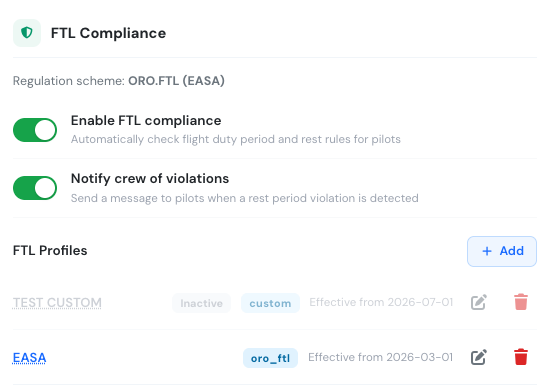
Section titled “1 — Enable FTL compliance”Go to Settings → Duty Limits and scroll to the FTL Compliance section on the right.
Turn on the FTL enabled toggle. From this point on, every duty record saved by the system (automatically or manually) will have its FDP and regulatory limit calculated and stored.
Note: existing duty records saved before FTL was enabled will not have FDP data until they are re-saved. New records created after enabling will calculate correctly.
Optionally enable Notify crew to send an automatic message to a pilot when their FDP is projected to be close to or over the limit.
2 — Create an FTL profile
Section titled “2 — Create an FTL profile”An FTL profile tells the system which regulatory scheme to apply and from when.
Click Add in the FTL Compliance section. Fill in:
| Field | Description |
|---|---|
| Name | A label for this profile, e.g. “ORO.FTL 2024” or “FAA Part 117”. |
| Regulatory scheme | ORO.FTL (EASA), 14 CFR Part 117 (FAA), or Custom. |
| Effective from | The date from which this profile applies. |
Click Save. You can have multiple profiles with different effective dates to handle regulatory transitions.
The system always picks the most recently effective active profile when calculating limits.
Viewing the FDP limit table
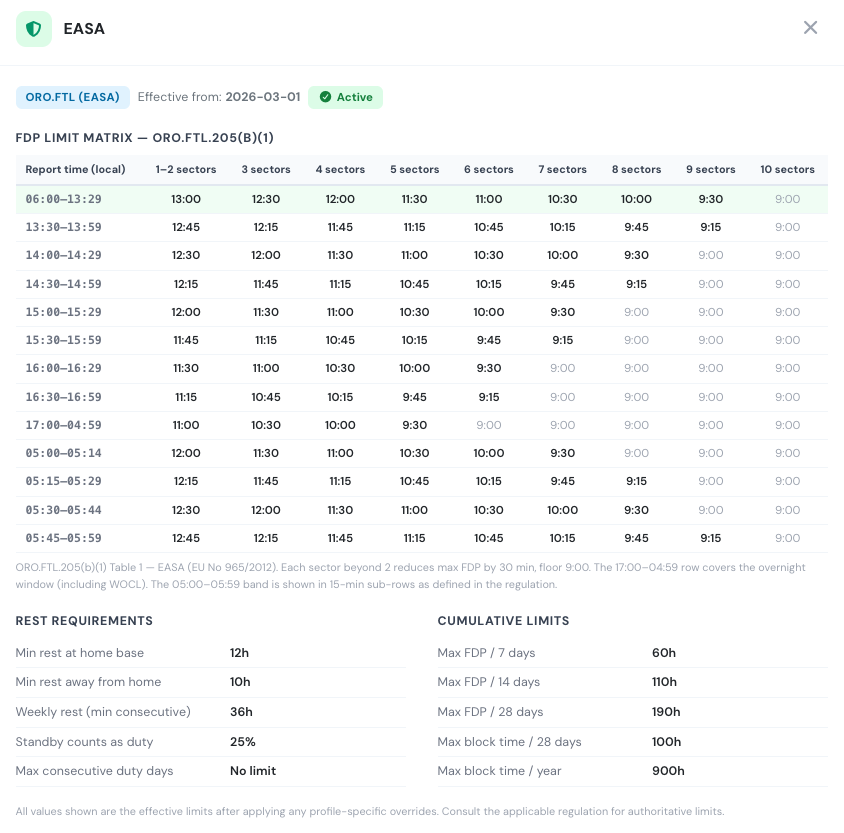
Section titled “Viewing the FDP limit table”Click any profile name in the FTL Compliance section (or click the profile badge / ? button on the FTL Forecast, Roster, or Schedule Manager pages) to open the profile detail panel.
The panel shows:
- FDP Limit Matrix — the full table of maximum FDP hours by report time and number of sectors, taken directly from the applicable regulation (ORO.FTL.205 Table 1, or 14 CFR §117 Table B). Values greyed out at 9:00 have hit the regulatory floor.
- Rest Requirements — minimum rest at home base and away, weekly rest, standby fraction, and maximum consecutive duty days.
- Cumulative Limits — maximum FDP and block time over rolling 7-day, 14-day, 28-day, and annual windows.
If the profile has custom rule overrides, a yellow callout lists which fields have been changed from the scheme default.
How FDP is calculated
Section titled “How FDP is calculated”When a duty record is saved, Flylogs:
- Finds the pilot’s flights for that day, separating the ones they operated (CM1 or CM2) from the ones they only supervised (the third crew seat).
- Takes the start of the duty period as the start of the FDP (minus any commute time configured in Duty Limits settings).
- Takes the latest arrival of a flight they operated as the end of the FDP.
- Looks up the regulatory FDP limit from the active profile using:
- The report time (local hour of FDP start)
- The number of sectors they operated
- Flags the record as a violation if the actual FDP exceeds the limit.
- Flags WOCL if the duty period overlaps the Window of Circadian Low (02:00–05:59 local).
Duty is not FDP
Section titled “Duty is not FDP”The two are counted differently, and supervision and simulator sessions are where they part company.
Duty covers what the operator asks of the crew member. Operating a flight (PIC or SIC seat) always puts it inside their duty period. Supervising a flight from the ground, or a simulator session, is also work — whether it counts as duty depends on the company type (see Supervision and simulator sessions below).
FDP is narrower. It ends at the last landing of a flight the person actually operated, and a flight they only supervised is not a sector: ORO.FTL.105(23) defines a sector as a segment of an FDP, from the aircraft first moving for take-off until it comes to rest. So supervised flights and simulator sessions never shorten the maximum FDP the way extra sectors do.
They reach the FDP in one case: when they happen before a flight the person operates that day. They have already opened the duty period, so the FDP is measured from there — the conservative reading.
Supervision and simulator sessions
Section titled “Supervision and simulator sessions”Two kinds of session are work but never flight time, never the end of an FDP and never a sector:
- Supervision — the person sits in the Supervisor seat of a flight on a real aircraft.
- Simulator sessions — any flight logged on an aircraft marked as a simulator, in any seat (PIC, SIC or Supervisor).
Neither ever counts towards the flight time limits (28 days, year, monthly), which only add up block time on real aircraft. How they count towards duty depends on the company type set in the company preferences:
| Company type | Session before or between operated flights | Session after the last operated flight, or on a day with no operated flight |
|---|---|---|
| AOC Operator, General Aviation | Duty | Duty |
| Flight School, SPO Operator | Duty | Work time only — not duty |
AOC Operator and General Aviation — duty wherever it falls. ORO.FTL.105(10) defines duty as “any task that a crew member performs for the operator, including flight duty, administrative work, giving or receiving training and checking, positioning, and some elements of standby”. Supervision and simulator training are such tasks, so they are duty before, between or after flights:
- They count towards the daily, weekly and monthly duty totals — the ORO.FTL.210 cumulative limits (60 h / 7 days, 110 h / 14 days, 190 h / 28 days). A day with only supervision or simulator sessions still produces a duty record.
- They extend the duty period, so the rest period (ORO.FTL.235) is counted from the end of the last session.
Flight School and SPO Operator — duty only when a flight follows. ORO.FTL applies to commercial air transport, not to training organisations or specialised operations, so Flylogs follows the narrower reading: a supervision or simulator session is duty only when a flight the person operates follows it before their rest. A session after the last operated flight of the day — or on a day with no operated flight at all — does not extend the duty period. It is added to the pilot’s work times instead: the work start and end are widened to cover it (never narrowed, so times a pilot entered by hand are kept).
Examples (commute times ignored):
| Day | AOC / General Aviation | Flight School / SPO |
|---|---|---|
| Simulator 07:00–09:00, then flies 11:00–12:00 | Duty and FDP 07:00–12:00, one sector, 1 h flight time | Same |
| Flies 08:00–10:00, then simulator 14:00–16:00 | Duty 08:00–16:00, FDP 08:00–10:00, 2 h flight time | Duty and FDP 08:00–10:00; work time to 16:00 |
| Flies 09:00–11:00, then supervises 15:00–17:00 | Duty 09:00–17:00, FDP 09:00–11:00 | Duty and FDP 09:00–11:00; work time to 17:00 |
| Supervises 07:00–08:00, then flies 09:00–11:00 | Duty and FDP 07:00–11:00, one sector | Same |
| Simulator or supervision only | Duty for the sessions, no FDP | No duty; work time covers the sessions |
FAA Part 117 reads the same way for the FDP: training before a flight segment is part of the FDP (117.3), training after the last segment is not.
Where violations appear
Section titled “Where violations appear”Once FTL is enabled, FDP data appears in three places:
Schedule Manager (while booking)
Section titled “Schedule Manager (while booking)”When you create, edit, drag or resize a booking, Flylogs projects the pilot’s FDP for that day — from the start of the first booking, less the commute before, to the end of the last booking on a real aircraft, with the number of those bookings as sectors — and compares it with the limit from your FTL profile. If it would be exceeded you get an FDP limit exceeded warning alongside the duty and rest warnings. With Block overtime scheduling on, the booking cannot be saved.
Simulator bookings follow the same rules as flown simulator sessions: one before the first flight opens the FDP, one after the last flight does not extend it, and they never count as sectors or flight time.
Draft and cancelled bookings are not counted. A booking where the pilot is the Supervisor opens the FDP when it comes before a flight they operate, but is never a sector. A multi-leg booking counts one sector per leg.
Pilot duty times grid (Pilots → Duty Times)
Section titled “Pilot duty times grid (Pilots → Duty Times)”The monthly grid shows each pilot’s daily FDP alongside their total duty time. Days with a violation are highlighted in red. A W badge indicates WOCL overlap.
The FDP (FTL) view shows each day’s FDP (report → last on-blocks). The Flight period view is different: first off-blocks to last on-blocks of the flights the pilot operated, with no report or commute time. When any pilot exceeded their FDP limit during the month, an FDP exceeded tile shows the number of days and a warning lists the pilots.
Pilot view page
Section titled “Pilot view page”Each pilot’s profile page shows the current FDP and limit for recent duty records.
FTL Forecast page (Schedule → FTL)
Section titled “FTL Forecast page (Schedule → FTL)”See the section below.
FTL Forecast page
Section titled “FTL Forecast page”The FTL Forecast page projects FDP figures from scheduled flights — before the duty records exist. It is a planning tool, not a compliance record.
Monthly navigation
Section titled “Monthly navigation”Use the ‹ and › arrows to browse months. The current day is highlighted in the column header.
Fatigue risk chart
Section titled “Fatigue risk chart”The bar chart at the top ranks pilots by their total projected FDP hours for the month. Pilots with at least one projected violation are shown in red. Use this chart to identify the most fatigued crew on the roster at a glance.
Day grid
Section titled “Day grid”Each row is a pilot. Each column is a day of the month. A cell contains:
| Content | Meaning |
|---|---|
Flight time (e.g. 7:30) |
Projected FDP for the day. |
| FDP badge (red) | FDP would exceed the regulatory limit for that report time and number of sectors. |
| W badge (orange) | Duty period overlaps the Window of Circadian Low (02:00–05:59). |
| SB (light blue) | Standby duty from the base schedule. |
| GD (grey) | Ground duty from the base schedule. |
Cell colours:
| Colour | Meaning |
|---|---|
| White / transparent | No scheduled activity. |
| Light blue | Standby. |
| Light grey | Ground duty. |
| Light green | FDP projected at less than 80 % of the limit. |
| Yellow | FDP projected at 80–99 % of the limit — approaching the limit. |
| Red / pink | FDP would exceed the limit — violation. |
Caveats
Section titled “Caveats”- The forecast is based on scheduled departure and arrival times. Actual FDP may differ if flights run early or late.
- Only flights with status other than CANCELED or DRAFT are included.
- Base schedule entries (standby, ground duty) are shown for context but do not generate FDP figures.
- The applicable FTL profile is the one active as of today, applied uniformly across the entire month shown.
Regulatory schemes
Section titled “Regulatory schemes”| Scheme | Applies to |
|---|---|
| ORO.FTL (EASA) | Airlines and AOC holders operating under EASA rules (EU, UK, and many other countries). Table-based FDP limits from ORO.FTL.205, extended when WOCL is involved. |
| 14 CFR Part 117 (FAA) | US air carriers under FAA flight and duty time rules. |
| Custom | Define your own FDP limits when your operations manual specifies values outside the standard tables. |
Frequently asked questions
Section titled “Frequently asked questions”My pilots have duty records but I see no FDP data. FDP is calculated when a duty record is saved. Records that existed before FTL was enabled need to be re-saved to trigger the calculation. New records will calculate automatically.
The FTL Forecast shows “No active FTL profile found”. No active profile exists with an effective date on or before today. Go to Settings → Duty Limits → FTL Compliance and add a profile with an effective date in the past or today.
Can I use FTL tracking without the ORO.FTL or FAA schemes? Yes. Choose the Custom scheme and Flylogs will still calculate FDP and flag violations using the limits you define in the profile rules.
Does my company’s regulatory authority (EASA, OACI, FAA, CAA) affect FTL? Only as a suggestion. The authority set in company details pre-selects the scheme when you create a profile — EASA/OACI suggest ORO.FTL, FAA suggests Part 117, any other authority suggests Custom. FDP calculation, forecast and violation flags run for every authority; what applies is the scheme of the active profile.
Does the FTL Forecast block scheduling? No. The forecast is read-only. To block schedule creation that would cause violations, use the Block overtime scheduling setting in the Duty Limits tab.
Can a pilot check their own limits? Yes. The Duty & Rest widget on the crew profile opens the Duty & FTL limits page, where each crew member sees every limit on any day — past, today, or ahead with their roster — and managers see the same page for any crew member.